
 editor daily mirror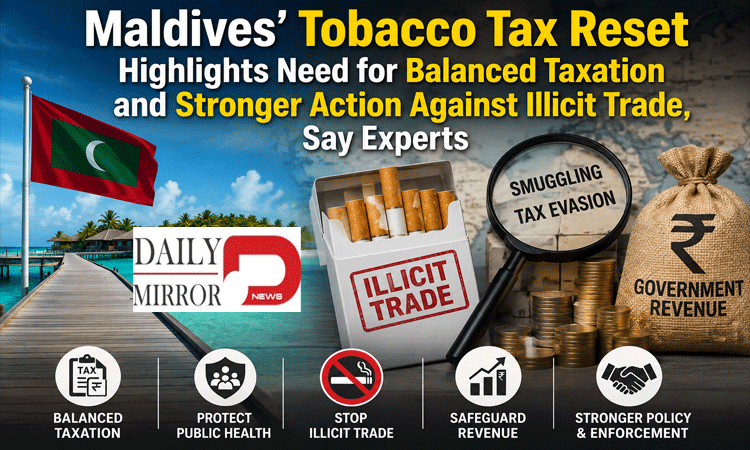
Dailymirror.news,National, August 5, 2026: The Maldives’ decision to reduce cigarette import duty by 50% after a surge in illicit tobacco trade has renewed debate over how governments can balance tobacco taxation with effective enforcement. Public health and policy experts say the development reinforces an important insight for India: tobacco taxation delivers the best outcomes when supported by strong enforcement, robust supply-chain monitoring and sustained action against illicit trade.
The Maldives recently reduced cigarette import duty from MVR 8 to MVR 4 per pack after authorities reported that previous tax increases had fuelled the growth of the illicit tobacco market, eroding legal sales and government revenues.
The policy review has attracted international attention because the country was recognised by the World Health Organization (WHO) with the 2024 World No Tobacco Day Award for strengthening tobacco-control measures, including higher tobacco taxation.
Speaking in Parliament, Maldives Minister of Finance and Planning Moosa Zameer said the decision followed discussions with the WHO and was intended to curb the growing illicit tobacco market after earlier tax increases encouraged consumers to shift to illegal products.
Read this also:Urban Company launches Native M3 Pro with 3year unconditional warranty and long life filtration..
Read this also:Uber Launches Bike Taxi Service in Warangal, Offers Free First Ride for Limited Period..
The Maldives joins a number of countries that have encountered similar challenges. Bhutan eventually relaxed its long-standing tobacco restrictions after widespread smuggling undermined the effectiveness of the ban, while Australia-despite having among the world’s highest tobacco taxes-continues to combat a large illicit tobacco market linked to organised crime and substantial excise revenue losses.
For India, one of the world’s largest tobacco markets, the experience reinforces the importance of ensuring that taxation policies are accompanied by effective enforcement. Experts note that illicit tobacco products evade taxes, circumvent mandatory packaging and health-warning regulations, and are often sold at significantly lower prices than legal products, weakening both public health efforts and tax compliance.
Read this also:Pallavi Model School Boduppal Hosts South Zone CBSE Boys Chess Championship 2026..
Dr Nandini Sharma, Ex Dean and Director Professor, Community Medicine, Maulana Azad Medical College, New Delhi, “International evidence consistently shows that tobacco taxation remains one of the most effective public health measures to reduce consumption.
However, taxation is most effective when accompanied by strong enforcement, supply-chain monitoring and coordinated action against illicit trade. A comprehensive policy framework should ensure that public health objectives are achieved without creating opportunities for illegal markets to expand.”
Experts emphasise that tackling illicit trade requires sustained investment in intelligence-led enforcement, stronger border controls, effective track-and-trace systems and closer coordination among enforcement agencies.
Dr Meenakshi N. Family Physician, Public Health Expert, Apollo Hospital, Noida, “The Maldives’ experience demonstrates that tobacco taxation should be evidence-based and supported by effective enforcement.
When illegal markets are allowed to flourish, they can undermine both public health goals and government revenues. The policy priority should therefore be to strengthen enforcement alongside taxation to ensure the intended objectives of tobacco-control measures are achieved.”
While each country’s policy environment is unique, recent international experience underscores a common principle: taxation alone cannot achieve optimal tobacco-control outcomes. For India, sustaining progress will require a comprehensive approach that combines appropriate taxation with strong enforcement, regulatory compliance and decisive action against illicit trade.